Chronicling the Future
Interactive briefings from the MTS newsroom, following the systems reshaping technology, money, and power.
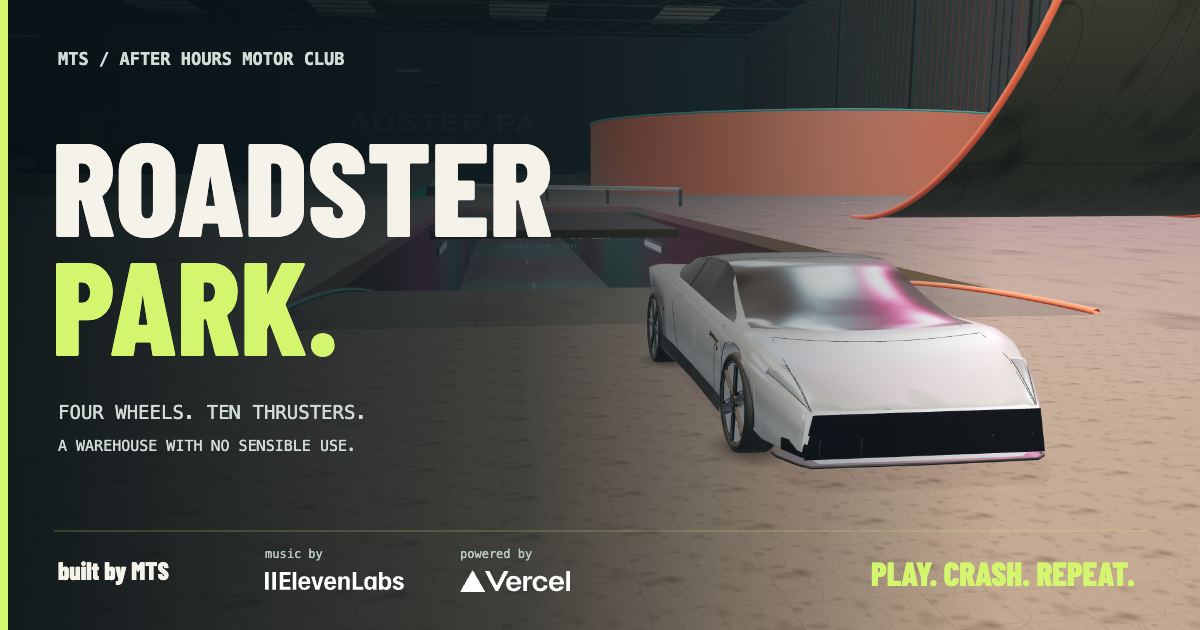
Roadster Park
Drift, jump, and fly a thruster-powered Roadster through a warehouse stunt park. Chase a personal best, then share your scorecard.
Drift, jump, and fly a thruster-powered Roadster through a warehouse stunt park. Chase a personal best, then share your scorecard.
Watch films, play games, explore worlds, and vote for your favorite before the models are revealed.
Explore an island of 42 landmark mathematics claims from OpenAI. Discover shrines, meet mathematical colossi, and learn what each result could mean.
Five engineers. Same scope. Five generations of software tools. Move from Early Cloud to the agentic era and see how a fixed five-person team could build six defining products, with every estimate's assumptions and sources open.
Your guide to how AI gets measured. Play a test and explore the tasks, test conditions, and evidence behind benchmark scores.
Starship's first planned trip to orbit, and its first working payload: 26 Starlink V3 satellites. Scrub the flight from Pad 2 to splashdown, cut open Super Heavy Booster 21 and Ship 41, and inspect every part along the way.
Fly Falcon 9 through two missions, Crew-13 to the ISS and a Starlink launch, from pad to booster landing. Cut the rocket open, inspect every part, and follow the live telemetry.
Explore the races and the balance of power with live Polymarket and Kalshi prices, mapped across the United States.
Follow a personal agent through its day: the tools, cloud computer, CPUs and GPUs doing the work. Explore what serving millions of people could require.
The physical stack behind AI: accelerators, clusters, power, cooling, and the infrastructure that makes intelligence possible.
The circuit kept shrinking. The system required to make it kept expanding. Nine bottlenecks trace how one switch became a global network of workers, fabs, tools, memory, packaging, and permission.
A goal in a knockout match creates a near-instant, planet-wide, synchronized spike — everyone refreshing, commenting, and betting in the same two seconds — then it craters. That vertical-spike-then-crater shape is exactly what serverless Postgres is built to absorb. Five live sections: broadcast wall (840k concurrent connections, one Postgres row), EKG autoscale with saturation gap and scale-to-zero, Crypto.com prediction markets on the same timeline, rotating globe following the sun, and 130 years of database history.
It's listening on every channel you own — that's the feature and the problem. A fake-macOS desktop whose one open app is a Safari-style browser: encyclopedia article, agent directory, forum thread, security advisory, RFC, and a working demo inbox, with cat, a resident terminal agent, navigating the tabs and answering the mail. OpenClaw, Hermes, the closed wing, the fork belt, and eighty years of lineage.
Boot into Sound System 11 — a black-and-white Windows-XP desktop — and try three ElevenLabs audio models live: Music V2 composes from a prompt, Voice Changer reskins your voice, and Scribe transcribes whatever you say. MTS × ElevenLabs.
In a single week, AI systems formally proved theorems and disproved an eighty-year-old Erdős conjecture about unit distances in the plane — twice, by two different labs. How AlphaProof, AlphaGeometry 2, and Claude Mythos work, what they proved against Lean's machine checker, and why a compiled proof collapses the gap between convincing and correct.
Eli Lilly's VERVE-102 is a one-shot, base-editing infusion that permanently disables the PCSK9 gene in liver cells. In the Phase 1b Heart-2 trial, a single dose lowered PCSK9 protein by up to 88 percent and cut LDL cholesterol by 62 percent on average at the top dose, with durable effects out to 18 months. A walk through the mechanism, the dose-response, the safety read, and what's still uncertain.
What world models are, how they work, what's next. A learned internal representation of an environment — compress observations into latent state, predict futures in imagination, plan without acting. A four-step playbook for generating a world frame-by-frame with a real world model (Decart's Oasis), the math behind DreamerV3/Genie/Cosmos/DreamZero, and recent signals from NVIDIA's DreamZero and Odyssey's Agora-1.
YC vocabulary across the Winter 2025 → Winter 2026 batches. Every one-liner and long description for ~680 companies, indexed for what's surging (agentic, claude code), collapsing (voice, compliance), and conspicuously absent (world model, MCP server) in early-stage founder pitches.
1,891 open roles across 122 recently-funded accelerator startups (YC W25+, a16z Speedrun, AI Grant). Median comp, equity rates, remote policy, and the must-have skill list — extracted from every job description by parallel Haiku agents.
A guided gallery through the foundational papers that built modern AI — from the 1943 McCulloch–Pitts neuron to DeepSeek-R1. Eleven eras, each with its own canvas, its own visual treatment, its own formula, and the three or four papers that actually mattered.
US-Japan venture capital intelligence — every Tier-1 arrival, deal, and macro signal flowing between Sand Hill Road and Tokyo. 74 records tracking the foreign capital build-out around Sakana, Rapidus, and SoftBank's reverse flow into OpenAI, with ¥/$ dual tracking and per-entity capital rosters.
Every 13F-HR filing from Situational Awareness LP — Leopold Aschenbrenner's hedge fund, built around an explicit AGI thesis. Quarter-over-quarter holdings, entries, exits, and per-position trade histories with live marks and option-leg detection.
Disclosed trades by members of Congress and their families, with the day-of, week-ahead, and 30-day price moves alongside each filing. Placeholder copy until the data freeze lands.
Every 13F-HR filing since mid-2023 from 45 curated funds, joined to Form 4 insider flow and adjusted-close prices, with rotation and consensus calls per quarter.
A twelve-step walkthrough of why AI memory is the next bottleneck — and what the production stack actually does about it today.
Eleven beats — a black-box app, a dependency tree, a maintainer at 11:47pm, a stealer harvest, an attacker session, a 760-org blast radius. Every 2025–2026 marquee breach fits the same chain; a receipts page ties each beat to 19 real named incidents.
Anthropic (May 11) and OpenAI (May 12) just declared every unauthorized secondary transfer void. Nine self-paced steps trace 1,000 ex-employee shares through three layers of SPVs — to 47 retail-accredited LPs at a +39% cumulative premium — before the announcement that hollowed the whole structure out.
A single gigawatt-scale AI data center costs ~$50B all-in — $25–50B of Nvidia silicon plus ~$20B of building, power, and cooling. AI bulls call it a 2-year payback; commercial-real-estate pros call it 10. Both numbers are arithmetically correct. The public filings show the upside staying with the AI companies while the downside has been pre-allocated to people who never saw the cap table.
An editorial frontend over war.gov's first UFO/UAP release — 161 declassified records from the FBI, NASA, and the Departments of War and State, geocoded onto a globe and indexed for full-text search.
Semantic search across all 199 trial-admitted exhibits in OpenAI v. Musk — emails, journal pages, contracts, screenshots — rendered in form-factor viewers that match the original document.
The viral “500 mL per query” figure conflated per-conversation with per-prompt on stale 2022 hardware. A bottom-up audit lands at ~3 mL — about a sip — and a single hamburger is two million prompts.
An interactive walkthrough of the trial — the first MTS subdomained visualization.